
The FFXIV Market Board is where Eorzea’s economy truly lives. Whether you’re a fresh sprout trying to fund your first apartment or a seasoned entrepreneur looking to flip Materia for profit, understanding how to navigate this system separates gil-flush players from strategic wealth-builders. This guide breaks down everything you need to know: how the Market Board works, where to find it, how to spot deals, and advanced tactics that’ll have your retainers drowning in currency. We’ll cover current mechanics as of patch 7.0, practical strategies that actually work, and the mistakes even experienced players make.
Key Takeaways
- The FFXIV Market Board operates as a datacenter-wide player economy where supply and demand determine prices, with retainer commissions ranging from 5–15% depending on sale price.
- Smart pricing requires analyzing the lowest 5–10 listings and undercutting by only 1–5% to attract buyers without destroying profit margins.
- Track price trends over two weeks to identify cyclical patterns in raid consumables, crafting materials, and seasonal items that create consistent flipping opportunities.
- Always account for retainer commissions in your profit calculations before listing items, as forgetting the fee can turn apparent profits into actual losses.
- Patch day spikes and seasonal demand cycles significantly impact item values, with new gear crashing in price within 24–48 hours while consumables spike during raid launches.
- Monitor your listings every 6–12 hours and avoid panic-cancelling; give the market time to stabilize rather than reacting to every undercut from competitors.
What Is The Market Board In FFXIV?
Understanding Market Board Basics
The Market Board is FFXIV’s player-to-player trading hub. It’s essentially a decentralized auction house where individual players list items for sale and others come to buy. Unlike NPCs who sell static goods at fixed prices, the Market Board is pure supply-and-demand economics.


Here’s what you’re actually doing when you interact with it: you’re either posting an item you want to sell, browsing items others have listed, or purchasing something at a price another player set. There’s no vendor intermediary, your gil goes directly to the seller (minus the retainer fee, which we’ll cover shortly).
The Market Board exists on a per-datacenter basis, not per-server. So if you’re on the NA Aether datacenter, you can see and trade with players across Adamantoise, Cactuar, Faerie, Gilgamesh, and all other Aether servers. This pooled market means better liquidity for popular items and tighter price competition overall.
You access the Market Board through Retainers, NPCs that act as your sales agents. Every player starts with two retainers, and you can own up to ten total across your account. Retainers are the only way to list items for sale: you can’t post directly yourself.
How The Market Board Works
Listing And Purchasing Items
When you want to sell something, you approach a Retainer and open the “Retainer > Sell Items” menu. You select what you’re selling, set your price, and choose the duration: 48 hours, one week, or two weeks. The item immediately goes live on the Market Board at your set price.
Buyers searching the Market Board see your listing alongside everyone else’s. If they want it, they purchase it right then. The transaction is instant, you don’t have to be online, and neither do they. The item leaves your retainer’s inventory, and the buyer receives it in their own.
Purchasing is equally straightforward. Open any Market Board terminal, search for what you want, sort by price (lowest to highest), and click the cheapest listing you find. Boom, you own it. If multiple players are selling at the same price, the oldest listing appears first. This matters more than you’d think when undercutting becomes relevant.
Commissions And Fees
Here’s the catch: selling isn’t free. FFXIV charges a retainer commission on every sale you make. The commission scales with the item’s sale price:
- Items selling for under 1 million gil: 5% of the sale price
- Items selling for 1 million to 50 million gil: 5% of the first 1 million, then 10% of everything above that
- Items selling for over 50 million gil: 5% of the first 1 million, plus 10% of the next 49 million, plus 15% of everything above that
So if you list a High-Quality Exarchic Coat of Healing for 500,000 gil, the commission is 25,000 gil. You pocket 475,000. That 5% on lower-price items stings less, but it adds up across multiple sales.
There’s no fee for purchasing, buyers only pay the listed price. And if your item doesn’t sell within the listing duration, it returns to your retainer at zero cost (aside from the lost opportunity).
How To Access The Market Board
Finding Market Board NPCs
Market Board terminals are stationed in every major city and settlement. On the datacenter network, you’ll find them in Limsa Lominsa (the hub), Ul’dah, Gridania, Kugane, Crystarium, Old Sharlayan, and Radiant’s Cauldron. The NPCs are labeled “Market Board” and are typically near the Aetheryte or main plaza of each city.
You don’t need to visit a specific board, they’re all connected on your datacenter. A listing made at Limsa shows up at the Ul’dah board too. Pick whichever city is most convenient. Many players camp out at Limsa since it’s the busiest, but traffic doesn’t affect your sales speed.
Retainers also have their own summoning bells (also labeled “Retainer Bell” or simply a bell icon). After hiring retainers, you interact with these bells to access your retainer’s inventory and post items for sale. You need to physically visit a bell to list items, but you can manage your retainer’s ventures and gear remotely once they’re hired.
Navigating The Interface
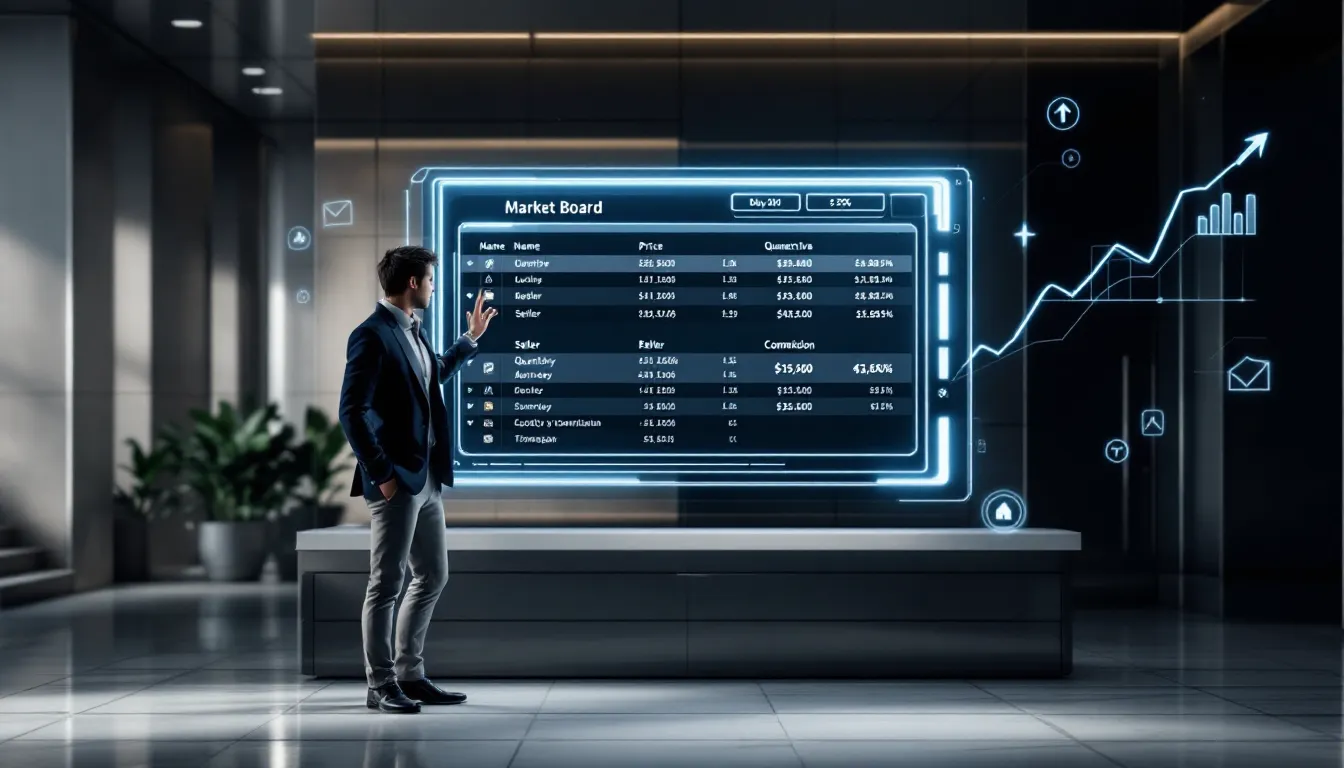
When you approach a Market Board, you see two main options: Browse Listings (buy stuff) and Post Selling Price (sell stuff).
On the Browse side:
- Search by item name or use category filters
- Results sort by price (lowest first, by default, adjust as needed)
- Each listing shows: price per unit, quantity available, retainer name, and posting time
- Click an item and confirm your purchase. It lands in your inventory instantly.
On the Selling side, you interact with your Retainer (at a bell):
- Go to “Retainer > Sell Items”
- Select what you want to list from their inventory
- Set your unit price and listing duration
- Confirm
The retainer screen also shows active listings, their status, and when they expire. You can undercut, raise prices, or cancel listings before they expire, all without a fee.
Market Board Strategies For Buying
Finding The Best Deals
Savvy buyers know that lowest price isn’t always the best deal. Volume matters. If a Gatherer’s Gloves are listed for 50,000 gil by one seller and 51,000 by another who has 50 units, the 51,000 listing might be the smarter buy if you need multiple pairs. You get faster confirmation and don’t have to wait for restock.
Always check the posting time. Items listed more recently at the same price might indicate the market is stabilizing there (good sign for the seller). Extremely old listings at a cheap price sometimes mean the seller’s offline or forgot about it, still a win for you, but those deals disappear fast.
For gear (armor, weapons, accessories), check the item’s rarity and whether it’s crafted or dropped. Crafted gear often has more competition and lower prices because supply is high. Dungeon-dropped gear with low drop rates will be pricier. Neither is a “bad deal”, it depends on your timeline and budget.
watch for patch-day spikes and price crashes. When a new patch lands and new gear drops, old gear tanks in price within 24-48 hours. Conversely, consumables (potions, food, stat buffs) spike during raid days and Savage tier launches. Timing your purchases around these cycles saves hundreds of thousands of gil.
Bidding Wars And Undercutting
Undercutting is listing an item cheaper than competitors. It’s the primary lever in FFXIV’s economy and drives constant price fluctuation. As a buyer, this works in your favor, prices naturally trend downward as sellers compete for sales.
As a seller (which we’ll cover more in the next section), undercutting is a double-edged sword. Undercut too aggressively, and you tank your profits. Don’t undercut at all, and your item sits unsold while competitors’ stock vanishes.
Monitor prices during your listing window. If you post a Materia VII for 80,000 gil and three hours later they’re selling for 60,000, you have options: cancel, relist lower, or let it ride. The market fluctuates constantly based on supply, demand, and how many sellers are actively competing. This is why checking the board every few hours during your selling window is essential if you’re chasing profit.
Maximizing Profits As A Seller
Pricing Your Items Competitively
Your first instinct might be to match the lowest price, don’t. That’s a race to the bottom where everyone loses gil. Instead, analyze the existing listings:
- Check the lowest 5–10 listings: What’s the typical floor price?
- Check quantity: How many units are listed at that price? If 100+ units exist at 40,000 gil, that’s the market’s decided price. Post there or accept slower sales.
- Assess your item’s specifics: Is yours high-quality? Materia-melded? Those justifiably cost more.
- Consider demand: New gear patches? Raid tier just dropped? Consumable prices skyrocket. Older expansion materials? They’re dirt cheap.
A solid strategy: undercut by 1–5% to stand out, but not 50%. If the lowest price is 50,000 gil, listing at 48,500 catches attention without destroying the market. If the floor is 100,000 but your item’s special, try 102,000, sometimes buyers will pay a slight premium for convenience or convenience of seeing it first.
For high-rotation items (potions, ethers, job stones, crafting materials), undercut modestly and expect brisk sales. For niche items (rare crafting mats, old gear, unique glamour pieces), price based on rarity and demand, even if it seems high. Patience beats volume here.
High-Demand Items And Flipping
Flipping is buying low and selling high. Identify cyclical price patterns and exploit them.
Examples that consistently move:
- Raid consumables (stat pots, ethereureal condensation, ancient grease): Cheap mid-week, expensive raid days. Buy Tuesday, sell Thursday.
- New crafting materials (post-patch gathering nodes): Expensive week one, tank within two weeks as supply floods. Buy after the crash, hold a week, sell at the next cycle.
- Popular glamour pieces (seasonal items, limited-edition armor): Buy during low-hype periods, resell when demand spikes.
- Materia tiers: Lower tiers often crash when higher tiers release. Stock up on VII and VIII when IX drops, then resell as people gear alt jobs.
The key is identifying trends before they peak. Resources like FFXIV market tracking communities and datacenter-specific Discord servers are goldmines for spotting patterns early. You don’t have perfect information, so start small, flip 10–20 units of an item, note the profit margins, scale up once you’re confident.
Always account for commission in your profit calculation. If you buy something for 50,000 and want to profit 25,000 (net 75,000 total), you need to sell it for roughly 79,000 (before 5% commission brings you to ~75,000). The math matters when margins are tight.
Common Market Board Mistakes To Avoid
Pricing Blind: Listing items without checking the current market. You might post a Crafted Coat for 150,000 when the market’s flooded at 60,000. Your item sits for a week unsold.
Ignoring Commission: Forgetting the 5–15% fee when calculating your break-even. You think you’re profiting when you’re actually losing gil. Always math it out before listing.
Listing High-Volume Items With No Urgency: Stacking 99 potions at a premium price in a slow market. They’ll sit. Either undercut slightly to move fast or break the stack into smaller batches with different price points to test elasticity.
Posting Gear Without Checking Materia: Listing job gear without noting whether it’s melded, what materia’s in it, or if it’s high-quality. Buyers assume it’s unmelded base gear at that price. Be transparent or adjust pricing.
Panic-Cancelling Listings: Undercutting exists. Watch the market, but don’t knee-jerk every time someone posts lower. Give your listing 6–12 hours before adjusting. Sometimes prices stabilize and climb back up.
Hoarding Niche Items Hoping They’ll Spike: Stockpiling old expansion materials expecting them to surge in value. Some do (rarely). Most slowly deflate as people farm more or find alternatives. Know your items’ actual demand curves.
Not Accounting For Datacenter Updates: Patches that significantly shift the meta, release new crafting materials, or buff old gear will swing prices wildly. An item worth 100,000 gil might tank to 30,000 within 48 hours post-patch. Don’t hold massive stock positions before major updates unless you’re confident.
Advanced Market Board Tips
Tracking Price Trends
Winning Market Board players obsessively track prices. You don’t need fancy tools to start, just discipline.
Screenshot or note the lowest three prices for your target items every few days. After two weeks, patterns emerge: Does this item’s price dip predictably mid-week? Does it spike on raid days? Does new content release cycle it upward? Once you spot the cycle, you’re ahead of 90% of sellers.
For items you’re actively flipping, track weekly. For long-term holds (investing in materials you think will rise), track bi-weekly. The effort compounds, you start making smarter listing and buying decisions almost immediately.
Using Third-Party Tools
Final Fantasy XIV’s economy is complex enough that third-party market analyzers have popped up. Tools like Universalis and Lodestone Market Data aggregators let you see cross-datacenter pricing, historical trends, and demand signals. Lodestone specifically shows character-by-character trading history, while Universalis crowdsources data from client-side market board scans.
These tools aren’t perfect, they depend on data uploads and might lag live market updates, but they’re invaluable for spotting regional price disparities and historical patterns. A material might be 50,000 on your datacenter but 70,000 on another. If you have alts there, that’s a flipping opportunity.
Be aware these tools exist in a gray area. SE hasn’t banned players for using them, but SE doesn’t explicitly endorse them either. Use them for analysis, not for automation or bots. FFXIV community discords often have dedicated market discussion channels where players share tool recommendations and market forecasts, worth joining if you’re serious about wealth-building.
Conclusion
The Market Board rewards knowledge and patience. New players often treat it as a quick shop, but veterans understand it’s FFXIV’s deepest economic layer. You can fund entire playstyles, housing, glam addictions, gear for alts, purely through smart buying and selling.
Start small: browse listings for items you craft or farm, note price patterns for a few weeks, then list strategically. Track commission and account for it in every calculation. Watch for patch-day swings and seasonal demand cycles. Most importantly, don’t chase perfect profits early, build habits and intuition first.
The players sitting on hundreds of millions of gil? They didn’t get there through single lucky flips. They got there through consistent, informed market participation over months. You can do the same. The Market Board’s waiting.