
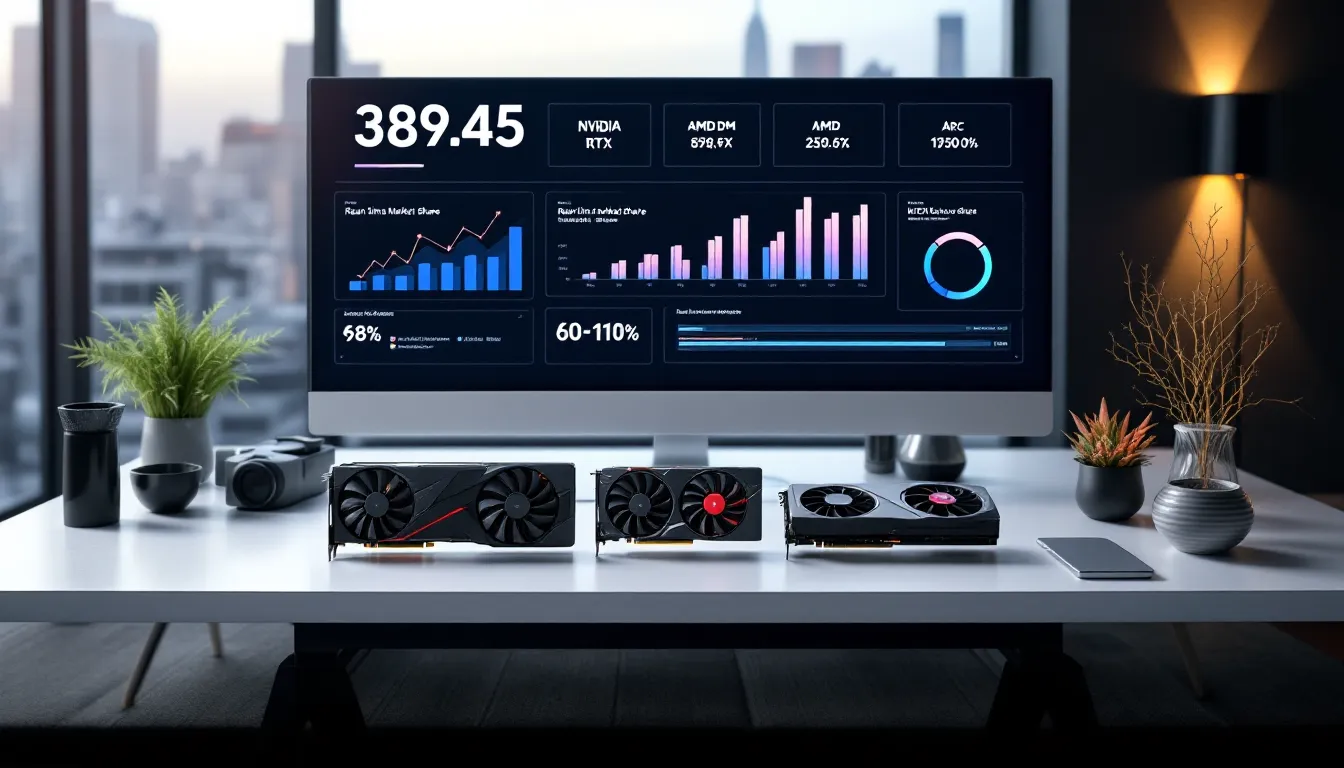
The GPU market share landscape has shifted dramatically over the past few years, and 2026 marks a critical inflection point for anyone building or upgrading their gaming PC. Gone are the days when the discrete GPU market was a quiet two-player game, now it’s a three-way battle that’s reshaping pricing, availability, and the future of gaming technology. Whether you’re a casual player hunting for your first mid-range card or a competitive gamer optimizing for frame rates, understanding who controls the GPU market share directly impacts which hardware you can afford, how well it’ll perform in your favorite titles, and how much manufacturer support you’ll actually get. This isn’t abstract corporate news, it’s the infrastructure beneath every frame you see on screen. Let’s break down what’s happening at the top of the GPU market, why it matters, and what it means for your next gaming build.
Key Takeaways
- NVIDIA’s dominant GPU market share of 80%+ in discrete graphics cards drives technology adoption and optimization, while DLSS 3 frame generation provides a significant competitive advantage for ray-traced gaming.
- AMD’s 15-18% market share has intensified competition in the GPU market, forcing NVIDIA to lower prices and offering gamers genuine alternatives with better value in the mid-range segment.
- Intel Arc’s emerging presence combined with NVIDIA and AMD competition creates a three-way battle that benefits gamers through improved driver support, faster innovation, and better pricing across all segments.
- GPU market share directly impacts pricing, availability, and software optimization—NVIDIA’s dominance subsidizes gaming R&D through data center profitability, while market competition ensures multiple credible options exist at nearly every price point.
- For practical gaming builds, choice of GPU should prioritize performance-per-dollar and specific gaming needs rather than market share trends, as modern alternatives from AMD and Intel deliver excellent value and compatibility.
Understanding the GPU Market Landscape
Key Players in GPU Manufacturing
Three names dominate the discrete GPU space: NVIDIA, AMD, and Intel. Each player brings different strengths to the table, and their market share determines which technologies get real-world adoption and which languish in niche applications.


NVIDIA remains the heavyweight. Their stranglehold on high-end gaming GPUs, AI acceleration, and data center applications has made them the de facto standard for performance-focused builders. AMD has carved out significant territory in the mid-range and value segment, offering genuine alternatives to NVIDIA’s RTX lineup with competitive pricing and solid driver support. Intel Arc, the relative newcomer, launched in 2022 with aggressive positioning in the budget-to-mid-range bracket, though adoption rates have been slower than Intel anticipated.
Beyond discrete cards, mobile GPUs, Qualcomm’s Snapdragon Adreno chips, Apple’s proprietary GPU cores, and ARM-based solutions, represent a massive chunk of total GPU shipments worldwide. Console gaming depends on custom GPU silicon designed specifically for PlayStation 5 and Xbox Series X/S hardware. When discussing “GPU market share” in gaming contexts, most focus on discrete PC graphics cards, but understanding the broader ecosystem matters for where gaming is actually heading.
Why GPU Market Share Matters to Gamers
Market share isn’t just trivia for finance analysts. It directly affects your gaming experience in several ways.
First, dominance drives optimization. When NVIDIA controls 80%+ of the gaming GPU market, developers prioritize NVIDIA’s proprietary tech, DLSS (Deep Learning Super Sampling), ray tracing implementations, and CUDA acceleration. Games launch with better NVIDIA driver support at day one. This isn’t conspiracy: it’s resource allocation. Studios optimize for the platform most of their players use.
Second, market share influences pricing and supply. A manufacturer with majority market share can push higher prices because demand outpaces competition. Conversely, underdog vendors fight harder on price and availability to gain ground. When competition heats up, like when AMD’s RDNA 3 generation offered compelling value, prices across the entire market shift downward.
Third, long-term technology adoption depends on market leaders. Ray tracing took years to become standard because NVIDIA pushed it aggressively. DLSS and FSR (FidelityFX Super Resolution) adoption rates correlate directly with how many gamers own each card type. If a market leader abandons a technology (or fails to support new APIs quickly), that tech struggles industry-wide.
Fourth, competitive pressure drives innovation. When Intel Arc started shipping, both NVIDIA and AMD accelerated driver updates and feature rollouts. A duopoly or monopoly in GPUs would mean slower innovation and less urgency to solve problems like stuttering, heat throttling, or driver conflicts.
Current GPU Market Share Leaders in 2026
NVIDIA’s Dominance and RTX Lineup
NVIDIA’s position in 2026 remains essentially unchallenged in discrete gaming GPUs. With an estimated 80%+ market share in discrete graphics cards for PC gaming, NVIDIA has leveraged its RTX 40-series lineup (Ampere still in circulation for value builds, Ada for mid-range, and highest-end) to maintain control. The RTX 4090, 4080, 4070 Ti Super, and 4070 Super represent the undisputed performance tier for gaming, and no competitor has a direct answer in pure rasterization performance.
NVIDIA’s real power, but, extends beyond raw compute. DLSS 3 with frame generation has fundamentally changed how high-end gaming is discussed. The ability to use AI to generate entire frames between rendered ones isn’t just a performance trick, it’s a paradigm shift that AMD’s FSR 3 only partially matches. Games like Cyberpunk 2077, Black Myth: Wukong, and Alan Wake 2 showcase DLSS 3’s advantages so clearly that many competitive and enthusiast gamers now view DLSS support as a purchasing factor.
The RTX 50-series, launching in early 2025 (Blackwell architecture), has reinforced NVIDIA’s dominance. Early benchmarks show generational improvements in both traditional rasterization and ray tracing performance. The 5090 is positioned as the only card that can maintain 4K 240+ FPS in modern titles with maximum settings, which has made it the aspirational card for streaming and competitive esports.
Critically, NVIDIA controls the software ecosystem. CUDA remains the dominant compute platform for AI acceleration outside gaming, meaning developers optimize CUDA paths first. This spillover effect means NVIDIA GPUs benefit from both gaming-specific and general-purpose software optimization.
AMD’s Strategic Positioning and RDNA Growth
AMD’s market share sits around 15-18% of discrete gaming GPUs, a solid second place that reflects genuine competition rather than token alternatives. The Radeon RX 7000 series (RDNA 3) captured mindshare by delivering 85-95% of RTX 40-series performance at 10-20% lower prices in comparable tiers. The RX 7900 XTX and RX 7900 XT offered compelling value propositions that forced NVIDIA to more aggressively price the RTX 4080 and 4070 Ti.
AMD’s FSR (FidelityFX Super Sampling) technology has improved significantly and now supports frame generation in FSR 3, directly competing with DLSS 3. The key difference: FSR is hardware-agnostic and open-source, meaning it works on NVIDIA cards too (though NVIDIA drivers may not optimize for it). This positions FSR as a democratizing technology, even if DLSS remains technically superior in most benchmarks.
Driver maturity has historically been AMD’s weakness, but the Radeon driver stack has stabilized remarkably since 2023. Regular updates, better ray tracing performance optimizations, and improved VR support have narrowed the gap. Gamers report fewer driver issues and better out-of-the-box experiences with modern Radeon cards compared to five years ago.
AMD’s RDNA 4 architecture, launching in 2025, represents another push to capture market share. Pricing and performance positioning suggest AMD is directly targeting NVIDIA’s mainstream customer, the RTX 4070 and 4070 Super buyers. If RDNA 4 delivers within 5-10% of performance at 15-25% lower cost, AMD could see meaningful share gains.
The challenge: NVIDIA’s AI and CUDA advantage is almost impossible to match short-term. AMD’s ROCm platform (the CUDA alternative) is improving but still lags in ecosystem maturity and developer adoption. This means AMD’s growth is limited mostly to gaming and traditional graphics workloads.
Intel Arc’s Emerging Presence
Intel Arc’s journey has been rocky but not hopeless. Launching in late 2022 with the Alchemist architecture, Intel’s discrete GPUs grabbed only 2-4% market share, far below internal targets. The Arc A770, A750, and A380 (and later A750M for laptops) were technically competent but suffered from immature drivers, inconsistent performance across games, and weak brand recognition.
But, Intel’s latest driver updates (released throughout 2025) have genuinely improved Arc’s competitive positioning. Performance gains in ray tracing optimization, reduced stuttering, and better game compatibility have made Arc a legitimate budget option. The Arc B580 (Battlemage architecture, announced early 2025) brought lower power consumption and improved efficiency, particularly for laptop integration where Intel has enormous distribution leverage.
Intel’s path to growth isn’t through dethroning NVIDIA or AMD, it’s through laptop integration and the budget discrete segment. Intel Arc integrated GPUs (like in 13th and 14th gen Core Ultra processors) represent millions of casual gamers who play esports titles, indie games, and lighter AAA games. That’s enough to build market presence and developer relations without fighting high-end graphics card wars directly.
The wildcard: Intel’s investment in GPU software and partnerships. Intel is aggressively supporting open standards like AV1 encoding and ray tracing via industry-standard APIs (rather than proprietary tech). This positions Arc as the “standards-friendly” alternative. For developers tired of optimizing for NVIDIA-specific features, Intel Arc offers an alternative path.
Gaming Performance Implications
Ray Tracing and DLSS Technology Leadership
NVIDIA’s market dominance isn’t just about having the fastest cards, it’s about owning the technology stack that defines modern gaming visuals. Ray tracing, introduced to gaming via NVIDIA’s RTX architecture in 2018, has become the visual standard for AAA games. The question isn’t whether a game has ray tracing anymore: it’s how much ray tracing performance a GPU can deliver.
NVIDIA’s tensor cores (specialized hardware for AI operations) execute ray tracing and DLSS algorithms with exceptional efficiency. The gap between NVIDIA and AMD in ray tracing performance has narrowed (AMD’s RDNA 3 is genuinely competitive now), but NVIDIA still holds a 10-20% advantage in pure ray tracing throughput at equivalent price points. More importantly, NVIDIA’s software (drivers, game profiles, optimization tools) has been refined across years of dominance.
DLSS 3’s frame generation feature remains NVIDIA’s most significant competitive advantage. By using AI to synthesize entire frames between traditional rendered frames, DLSS 3 effectively doubles frame rates in supported games, a massive benefit for competitive FPS gaming and smooth 4K gameplay. Cyberpunk 2077 with DLSS 3 on an RTX 4090 can sustain 4K 60+ FPS with maximum settings, something traditional rasterization alone can’t achieve. AMD’s FSR 3 frame generation arrived later and doesn’t integrate as tightly with driver-level optimizations, leading to slightly more artifacts and less consistent performance.
The implication for gamers: if you play ray-traced AAA titles competitively or want future-proofed performance, NVIDIA cards get the advantage of maturity and optimization. But if you prioritize value or play games that leverage open standards (Vulkan, DirectX 12), the gap shrinks considerably. Indie games and esports titles (CS2, Valorant, Apex Legends) don’t benefit from DLSS or ray tracing anyway, making GPU choice less critical for competitive shooters.
Value and Performance Per Dollar
Market share battles are eventually fought in the value segment. NVIDIA’s RTX 4070 costs around $380-420 MSRP and delivers roughly 70-75% of the RTX 4090’s performance. AMD’s RX 7800 XT sits at $300-330 MSRP and delivers 65-70% of NVIDIA’s equivalent. For a 1440p 144Hz build (the most common enthusiast target), both cards are overkill: either plays every modern game at 100+ FPS with high settings.
The true battleground: the $200-300 segment. NVIDIA’s RTX 4060 Ti 8GB and RTX 4070 dominate here, but AMD’s RX 7600 (budget) and RX 6700 XT (value-midrange) offer comparable performance at lower cost. A gamer building a 1440p 60Hz rig will find better value in AMD: a gamer planning to upgrade to 4K in 2-3 years might accept NVIDIA’s premium for DLSS 3 future-proofing.
Performance-per-watt also matters for gamers facing rising electricity costs and thermal constraints. NVIDIA’s efficiency (due to tensor optimization) means lower power bills and quieter cooling solutions. AMD’s RX 7000 series still consumes slightly more power, though the gap has narrowed from previous generations. Intel Arc, with aggressive power optimization in Battlemage, offers the best watt-for-watt performance in the budget segment, if driver support remains solid.
Access to comprehensive hardware reviews and benchmarks from established tech outlets helps gamers compare actual FPS numbers across dozens of games before committing to a purchase. Market competition forces these outlets to maintain rigorous testing standards, which benefits consumers.
Mobile and Console GPU Market Trends
Mobile Gaming and Snapdragon Dominance
When discussing GPU market share, mobile GPUs represent the largest single segment by unit volume. Qualcomm’s Snapdragon platform powers over 70% of high-end Android phones globally, with the Adreno GPU being the standard mobile graphics processor for flagship devices. The latest Snapdragon 8 Gen 3 integrates an Adreno GPU capable of delivering console-level graphics for games like Honkai: Star Rail and Genshin Impact on smartphones.
Apple’s proprietary GPU cores (integrated into the A-series and M-series chips) control the iOS ecosystem. The A18 Pro GPU in iPhone 16 and M4 GPU in iPad Pro push mobile gaming performance to new heights. Games developed for iOS often showcase graphics quality rivaling entry-level PC gaming from just 3-4 years ago.
From a pure market share perspective, mobile GPUs dwarf discrete PC graphics cards. Qualcomm, Apple, ARM (Mali GPU designs), and MediaTek collectively ship billions of GPU cores annually compared to NVIDIA’s annual discrete card shipments. But, for gaming specifically, the conversation differs. High-end mobile gaming (called “console gaming” in mobile markets) is dominated by Snapdragon and Apple, while budget and mid-range gaming spans dozens of GPU designs across different manufacturers.
The importance to PC gamers: mobile gaming trends influence where studios invest development resources. A game optimized for Snapdragon 8 Gen 3 requires different architectural considerations than a PC title, but technical innovations (like variable rate shading and AI-driven upsampling) flow between mobile and PC gaming ecosystems. The success of DLSS and FSR on PC has encouraged similar technologies in mobile GPU drivers.
Console Market and Custom GPU Solutions
PlayStation 5 and Xbox Series X/S run custom-designed AMD GPU cores optimized specifically for console gaming. These aren’t off-the-shelf discrete cards but semicustom silicon built into system-on-a-chip designs. The PS5’s GPU is a customized RDNA architecture with 10.28 teraflops of compute, while the Xbox Series X runs a similar design at slightly higher clocks.
Console GPU market share is irrelevant in traditional market analysis, but the implications matter enormously. Console optimization drives game development priorities. When a game launches on PS5/Xbox and PC, studios optimize the console code first (larger installed base), then port those optimizations to PC GPU architectures. This means AMD’s RDNA architecture receives significant attention in game engine optimization because console gaming relies on it.
Conversely, NVIDIA’s PC dominance doesn’t directly influence console development (since Sony and Microsoft use custom AMD chips), but it influences which graphics features appear in cross-platform games. DLSS-optimized code on PC doesn’t translate to console optimization, but the techniques behind DLSS (frame reprojection, AI upsampling) inform how console developers approach performance budgets.
The longer-term implication: PS5 and Xbox Series X/S are 3-4 years into their lifecycle (as of 2026). When next-generation consoles launch (likely 2027-2028), AMD will again dominate the custom GPU market. This virtually guarantees continued relevance of RDNA architecture in PC gaming, even if discrete GPU market share shifts.
What’s Driving Market Share Changes
AI Acceleration and Data Center Growth
NVIDIA’s market share strength extends far beyond gaming into AI acceleration and data center computing, a market worth hundreds of billions of dollars. The H100, H200, and upcoming Blackwell data center GPUs generate more revenue and profit per unit than consumer gaming cards, and this dominance indirectly strengthens NVIDIA’s position in gaming.
Why? Because NVIDIA can invest heavily in gaming software (driver optimization, game partnerships, technology development) knowing that the data center business funds it. AMD and Intel compete in data centers too, but neither has achieved NVIDIA’s scale. This asymmetry means NVIDIA can afford to pursue ambitious projects like DLSS 3 and frame generation that may not pay off immediately in consumer sales but lock customers into the ecosystem.
Data center GPUs also influence gaming architecture decisions. CUDA, originally designed for data center compute, has become so entrenched in software development that NVIDIA benefits from decades of software investment in non-gaming applications. Machine learning libraries, simulation software, and rendering tools that run on CUDA further entrench the platform.
For gamers, this matters because it means NVIDIA’s competitive advantages in gaming (DLSS, ray tracing driver optimization) are subsidized by data center dominance. AMD’s consumer gaming improvements are real, but AMD can’t match NVIDIA’s R&D spending on gaming software without abandoning other markets where it’s less dominant.
Supply Chain Evolution and Manufacturing Capacity
GPU market share in 2026 is influenced heavily by manufacturing capacity and semiconductor supply chain dynamics. NVIDIA uses TSMC’s most advanced manufacturing nodes (currently 5nm and moving toward 3nm), while AMD also relies on TSMC. Intel manufactures some Arc GPUs internally and partners with external foundries for others.
Supply constraints that plagued 2021-2023 have largely resolved, but manufacturing capacity remains a bottleneck. TSMC’s capacity is finite, and NVIDIA’s enormous orders consume significant wafer allocation. This means AMD must compete not just on product merit but on manufacturing priority. When TSMC is capacity-constrained (which happens regularly), NVIDIA’s larger orders get priority, potentially limiting AMD’s ability to ramp production of a successful product like the RDNA 4.
The implication: market share can shift quickly when supply constraints ease (like 2023-2024) but returns to predictable patterns as capacity tightens again. AMD’s ability to grow market share is partially dependent on securing foundry capacity, not just designing better GPUs.
Intel Arc’s manufacturing challenges were particularly acute. Intel initially tried to manufacture Arc internally at company fabs, a risky move given competition from TSMC and Samsung’s advanced nodes. As Arc matured, Intel shifted to external foundries, improving yields but reducing control over production timelines. This complexity explains some of Arc’s slow market penetration.
Recent GPU news and analysis from tech outlets cover supply chain shifts and manufacturing announcements that directly affect market availability and pricing within months.
How Market Share Affects Gamers
Pricing Trends and Availability
GPU market share directly determines pricing power. When NVIDIA controlled ~85% of discrete gaming GPUs, RTX cards commanded premium pricing even for mid-range models. The RTX 3060 Ti maintained a $400 price tag for nearly two years even though newer alternatives, because supply couldn’t meet demand and competition was limited.
AMD’s RDNA 3 generation (2023-2024) changed this dynamic. By offering genuinely competitive performance at 10-15% lower prices, AMD forced NVIDIA to respond. The RTX 4070 Super price dropped to match AMD’s positioning, and competition heated up in every price segment. Gamers benefited from better value across the board.
Availability follows market share too. When one manufacturer dominates, their products are easier to find (high production) but more expensive. Underdog vendors fight harder on price and availability, offering better deals to secure distribution. A gamer in 2024-2025 had three legitimate options at nearly every price point (NVIDIA, AMD, Intel), leading to better inventory and more aggressive pricing than during pandemic shortages.
Current pricing (early 2026): The RTX 4090 still costs $1,600-1,800 even though being a year old, because demand exceeds supply and no AMD equivalent exists. But the RTX 4070 and RX 7700 XT compete directly around $300-350, preventing either from commanding huge premiums. This competition benefits gamers looking to build practical 1440p gaming rigs.
Looking forward, NVIDIA’s next-generation Blackwell consumer cards (5090, 5080, 5070, etc.) will reset pricing expectations. Launch MSRPs will be announced early 2025, and AMD’s response cards will follow. Market share shifts could occur if AMD undercuts NVIDIA on pricing or if Intel Arc gains legitimacy in the budget segment.
Software Optimization and Driver Support
Market share determines which driver optimizations get priority. When a game launches, studios work directly with GPU manufacturers on day-one driver optimizations. NVIDIA’s 80%+ market share means game developers optimize NVIDIA driver performance first, often launching with day-one NVIDIA driver updates from the top gaming publishers.
AMD’s driver support has improved dramatically (as mentioned earlier), but there’s still an optimization gap. Games might launch with NVIDIA drivers that achieve 5-10% better performance, with AMD driver optimization arriving in updates weeks or months later. This isn’t because AMD’s drivers are bad, it’s resource allocation. Developers have limited optimization budgets and prioritize the largest customer base.
Ray tracing and DLSS optimization suffer from the same phenomenon. Games supporting DLSS get NVIDIA’s engineering support during development, leading to tighter integration and better performance. FSR support is added reactively, often by different teams. This isn’t malice: it’s the reality of market dominance.
Proprietary features (NVIDIA’s CUDA, DLSS, PhysX: AMD’s FSR, AV1 encoding) get preferential treatment in games where developers carry out them. An NVIDIA-dominant market naturally tilts toward NVIDIA technologies.
Competitive games and esports titles are less affected because they rarely use advanced graphics features. CS2, Valorant, and Dota 2 run identically on NVIDIA and AMD hardware (both at 300+ FPS on high-end cards). Driver optimization matters far less for these titles.
For gamers, this means: if you play ray-traced AAA titles, an NVIDIA card gets better optimization. If you play esports or indie games, GPU choice matters far less. Medium-ground gamers (1440p 60-120 FPS gaming) won’t notice driver optimization differences in practice.
Recent PC gaming hardware guides and reviews discuss driver optimization and real-world performance across dozens of games, helping readers understand whether NVIDIA’s software advantages justify the price premium.
Future Predictions for GPU Competition
Emerging Technologies and Innovation Pressure
Market competition drives innovation, and 2026-2027 will bring several important technologies to GPU gaming. Frame generation (DLSS 3 and FSR 3) will become mainstream as more games support it and as AMD’s implementation matures. By 2027, frame generation support might rival ray tracing in ubiquity, fundamentally changing how gamers evaluate GPU performance.
AI-driven upsampling and noise reduction in games will accelerate. Technologies like super-sampling and denoising improve image quality while reducing compute load, allowing GPUs to achieve better visual fidelity at lower power consumption. NVIDIA’s current advantage here is substantial, but AMD and Intel will catch up as developers adopt open standards and APIs.
Mesh shaders and variable rate shading (VRS) will become more common in game engines. These features exist today but see limited adoption: as GPU competition heats up and engines optimize for them, they’ll shift how games look and perform. Neither NVIDIA, AMD, nor Intel has a massive advantage here, VRS is standardized in DirectX 12 and Vulkan.
Open standards will gain traction as a response to NVIDIA’s dominance. The Khronos Group’s standards (Vulkan, OpenGL, glTF) are gaining adoption because they reduce dependencies on proprietary vendor tech. As more indie developers and smaller studios adopt Vulkan, NVIDIA’s CUDA advantage shrinks slightly. AMD and Intel both support open standards aggressively, positioning themselves as “standards-first” alternatives.
Intel Arc’s roadmap includes aggressive updates to driver optimization and game partnerships. If Intel can secure developer mindshare for Arc-specific optimizations (similar to how NVIDIA has DLSS), market share could shift. This is Intel’s most likely path to growth, not overtaking NVIDIA, but establishing Arc as the third-place alternative that’s credible for enthusiast builds.
Long-Term Market Outlook for Gamers
By 2028-2030, the GPU market will likely stabilize around 70-75% NVIDIA, 18-22% AMD, and 5-10% Intel (in discrete PC gaming). This prediction assumes no major disruptions like manufacturing breakthroughs or surprising consumer shifts.
NVIDIA’s dominance will likely persist because the moat, CUDA software ecosystem, DLSS technology, driver maturity, brand loyalty, is hard to overcome. But, NVIDIA’s growth will slow as the market matures and competition stabilizes. The days of 85%+ market share are probably over.
AMD will remain the aggressive number-two player, periodically launching competitive products that force NVIDIA to respond. AMD’s strength in value-oriented gaming (1440p 60-120 FPS builds) makes it a permanent market player. If AMD’s upcoming data center GPU (MI-series) gains traction, the company’s overall R&D budget will increase, potentially accelerating gaming innovation.
Intel Arc will remain niche for desktop/discrete cards but will become increasingly important in laptop integration. Intel’s control of laptop CPU+GPU integration (Intel Core Ultra and future iterations) gives Arc enormous distribution leverage even if discrete Arc cards never reach NVIDIA’s volumes.
Mobile GPUs (Snapdragon, Apple) will continue dominating raw unit shipments, but discrete PC graphics will remain the enthusiast gaming standard for years. Console gaming will stick with custom AMD GPUs through the next generation, keeping RDNA architecture relevant.
For gamers, this outlook means: buy what offers the best value for your use case today, not what you think will be dominant in five years. Market share shifts happen, but GPU longevity (a good card stays capable for 4-6 years) makes current performance and features more important than speculative future trends. NVIDIA’s advantages justify the premium if you play ray-traced games extensively: AMD offers better value if you prioritize price-to-performance: Intel Arc is worth considering in budget builds as driver support stabilizes.
Conclusion
GPU market share in 2026 tells a story of dominance, competition, and shifting priorities in gaming technology. NVIDIA’s overwhelming position in discrete graphics cards reflects years of innovation, strategic partnerships, and a software ecosystem that’s difficult to replicate. Yet NVIDIA’s market share hasn’t increased in years, it’s holding steady while AMD and Intel nibble at the edges, pulling market share through better value and emerging technologies.
For gamers, the practical takeaway is straightforward: you have real alternatives now. Five years ago, the choice was NVIDIA or budget compromise. Today, you can build excellent gaming rigs with NVIDIA, AMD, or Intel cards, each with genuine tradeoffs to consider. Competition is pushing prices down, improving driver support across the board, and forcing manufacturers to optimize for open standards rather than proprietary lock-in.
The GPU market share landscape will evolve, technology breakthroughs, supply chain shifts, and unexpected innovations always disrupt predictions. But the competitive three-way battle (NVIDIA dominance, AMD challenge, Intel emergence) appears stable for the next 2-3 years. Smart gamers will ignore hype about market dominance and focus on what matters: frame rates, image quality, price, and how well a card aligns with their specific gaming priorities. The best GPU is the one that delivers your target performance at the price you’re willing to pay, and market competition ensures multiple good answers exist at nearly every price point.