

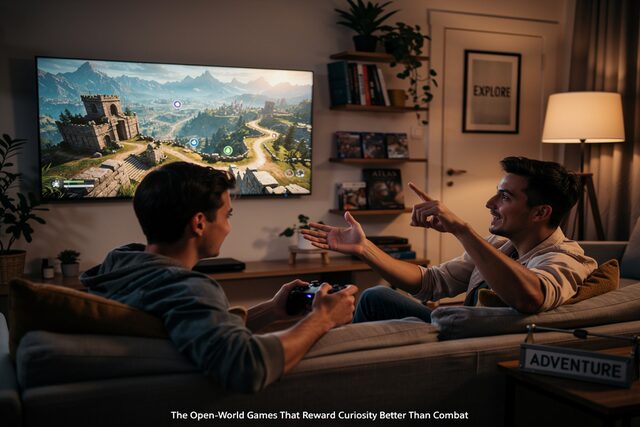
Let’s cut the marketing garbage. Most open-world games sell you “freedom” and then punish you for wandering off the golden path. You get a map bloated with icons, a quest log that reads like a spreadsheet, and combat that exists because a producer somewhere decided players need something to hit. Curiosity gets treated as a side hobby, not the point. But a handful of games actually flip that equation, and after years of grinding through checklist-driven junk, I’ve learned to appreciate the ones that treat exploration as the reward itself.
The Problem With Combat-First Design
Combat is easy to design and easy to sell. You slap a difficulty curve on it, add loot, and call it engagement. The trouble is that combat rarely makes you think about the world. It makes you think about your cooldowns. The games worth defending are the ones where the environment poses the questions and your brain supplies the answers. Critics who compiled lists of exploration-focused titles keep pointing at the same truth: when a world respects your intelligence, you don’t need a health bar to feel invested.


Think about the moment you spot a distant peak and just decide to walk toward it. No waypoint. No quest marker screaming at you. That instinct is what good design protects and bad design smothers under fifty tutorial prompts.
What Curiosity-Driven Worlds Get Right
The best of these games hide their secrets in geometry, in silence, in the way light falls on a ruin. They trust you to notice. Breath of the Wild is the obvious poster child, but the deeper catalog runs through titles like Outer Wilds, Subnautica, and Myst-descendants that never hand you a sword at all. Analysts breaking down games that reward player curiosity note a common thread: discovery is its own currency. You poke at something, the world responds, and that feedback loop replaces the dopamine drip of killing enemies.
It’s the same psychological hook that keeps people spinning a Book of Ra game for the reveal of the next symbol. Anticipation of the unknown does more heavy lifting than any boss fight. The difference is that a well-built open world pays off that anticipation with meaning rather than a payout screen, and that meaning is what keeps me coming back long after the credits.
The Games That Actually Deliver
Outer Wilds deserves its own paragraph because it weaponizes curiosity so completely that combat would ruin it. You die, the time loop resets, and your only weapon is knowledge. Every solution lives in your head, not your inventory. Subnautica does something similar underwater, where fear and wonder push you deeper without ever demanding you fight the ocean itself.
Then there’s the quieter crowd. Games like Firewatch, Journey, and Sable ditch violence and hand you a landscape to read. Roundups of the most rewarding open worlds keep circling these titles because they prove a world can be dense and alive without a kill count. The reward is understanding where you are and why it matters, which is more than most eighty-hour epics manage.
What ties these together is restraint. They don’t over-explain. They let you be wrong, wander, backtrack, and stumble into revelations. That friction is the feature, not the bug, no matter how many focus groups want it sanded down.
Why the Industry Keeps Ignoring This
Money. That’s the short answer. Combat systems justify sequels, DLC, microtransactions, and endless power-creep. Curiosity is harder to monetize because once you’ve solved the mystery, you’re done. There’s no grind to sell you. Writers dissecting worlds built around curiosity rather than objectives point out that these games often come from smaller studios precisely because the big publishers can’t stomach a design that respects the player’s time and doesn’t nickel-and-dime them into oblivion.
It’s a shame, because the appetite is clearly there. Every time one of these games breaks out, the same executives who greenlit another open-world icon-fest act surprised. They shouldn’t be. People are exhausted by busywork disguised as adventure.
The Bottom Line
If you’re tired of maps that treat you like a data-entry clerk, go play the games that trust you. Turn off the markers. Wander. Get lost on purpose. The genuine thrill of open-world gaming was never about clearing camps or leveling gear. It was about the horizon and the stubborn urge to find out what’s behind it.
Combat will always have its place, and there’s nothing wrong with a good fight. But the games that endure in memory are the ones that made you feel clever, curious, and small in the best possible way. Those are the worlds worth living in, and they’re the ones I’ll keep defending against every checklist-obsessed sequel the industry keeps shoving down our throats.