

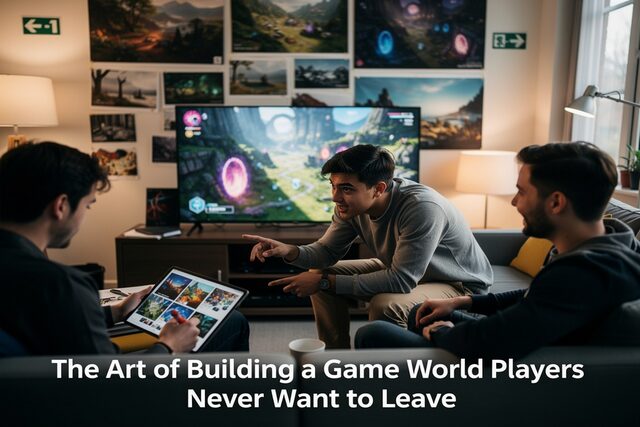
Let’s cut the marketing garbage. Most game worlds are hollow. They look gorgeous in trailers, sell a million copies, and get abandoned within a week because nobody bothered to make them matter. Building a world players refuse to leave has nothing to do with polygon counts or sprawling maps. It’s about making a place feel lived-in, consequential, and worth caring about. After years of watching studios chase trends instead of substance, I’ve stopped being polite about it.
Stop Confusing Size With Depth
Executives love the word “open world” because it photographs well on a spreadsheet. But an enormous map full of copy-pasted outposts and radio-tower busywork is a graveyard, not a destination. The people who actually study this craft understand that designing open worlds means restraint as much as ambition. Every square kilometer you add is another square kilometer you have to justify with meaning. If a player crosses your terrain and feels nothing, you’ve built a screensaver.


Density beats scale. A tight, handcrafted district where every doorway hides a story will outlast a continent of procedural filler. Players remember specific moments, not acreage.
Coherence Is Everything
A world falls apart the second its own rules contradict each other. If your lore says magic is forbidden but every shopkeeper sells fireball scrolls, players stop believing. Belief is the whole game. The fundamentals of serious worldbuilding demand internal consistency, an economy that makes sense, factions with actual motives, and a history that shaped the present. You don’t need to dump all of it on the player. You need to make them feel it exists underneath every interaction.
This is where lazy studios cheat. They write a wiki nobody reads instead of embedding the story into environments, item descriptions, and overheard conversations. Show me a ruined village and let me infer the war. Don’t hand me a codex entry and call it immersion.
Give Players Reasons, Not Just Rewards
Loot loops are a crutch. Sure, dopamine keeps people clicking, and the same psychology powers everything from mobile games to a slick online casino interface. But addiction mechanics aren’t the same as attachment. A world worth staying in gives players agency that echoes back. Their choices should reshape something visible, whether that’s a settlement they rebuilt or a rival they spared. When actions evaporate the moment you walk away, so does investment.
The teams that get this right treat player pull as an emotional problem, not a retention metric. Solid analysis on game worlds that grip players keeps circling the same truth: people stay where they feel they belong, not where they’re being farmed for engagement hours.
Characters Anchor the Place
Nobody weeps over a landscape. They weep over the blacksmith who died, the companion who betrayed them, the town that remembered their name. Populate your world with people who have wants and flaws, who react to what the player does, and who exist beyond a quest marker. A single memorable NPC can do more for immersion than an entire biome.
This costs writing talent and voice direction that most budgets treat as optional. That’s the mistake. Cutting narrative to fund another graphical showcase is how you end up with a beautiful, forgettable ghost town.
Details Are the Whole Point
Weather that shifts. Shops that close at night. Guards who comment on your reputation. Footprints in snow. These small systemic touches convince the subconscious that the world keeps turning whether you’re watching or not. Practical guidance on improving your world-building keeps hammering this point, and it’s right. The magic lives in the accumulation of tiny, honest details, not in one hero feature you slap on the box art.
The catch is that details are expensive and invisible until they’re missing. Bean counters slash them first. Then they wonder why the finished product feels dead.
The Uncomfortable Conclusion
Building a world players never want to leave is unglamorous work. It’s consistency, character, consequence, and obsessive attention to the mundane. There’s no shortcut, no engine that does it for you, no trend that replaces genuine craft. The studios still willing to sweat those details are the ones building places people call home. Everyone else is just selling expensive wallpaper and hoping nobody notices before the refund window closes.