The video game crash of 1983 nearly buried the burgeoning industry under a tide of low-quality titles, market saturation, and consumer distrust. Retailers, once eager to stock every new cartridge, became wary—sales plummeted, stores cleared their shelves, and developers shuttered their studios. In this dire landscape, an unassuming Japanese console arrived in North America in 1985 under a rebranded guise: the Nintendo Entertainment System (NES). What followed was nothing short of a rescue mission that not only revived home gaming but also reshaped the industry’s business practices, design philosophies, and cultural stature. Here’s how Nintendo turned a near-dead market into a thriving global phenomenon.
1. The 1983 Crash: An Industry Implodes
1.1 Saturation and Shoddy Software
During the late 1970s and early 1980s, video games exploded in popularity. Atari’s 2600 console sold millions of units, and dozens of third-party developers flooded the market with cartridges. However, the rush for quick profits led to a deluge of poorly designed, buggy, and derivative titles—E.T. the Extra-Terrestrial infamously became a poster child for the crash, with millions of unsold cartridges buried in a New Mexico landfill.


1.2 Retailers’ Backlash
As consumers returned subpar games in droves, retailers lost faith. Major chains like Woolco, Kmart, and Toys “R” Us slashed their video game sections or eliminated them entirely. By 1984, industry revenue had fallen from around $3.2 billion in 1982 to a mere $100 million.
1.3 A Vacuum for Innovation
The crash didn’t just wipe out excess inventory—it destroyed consumer confidence. Developers and investors steered clear, convinced the home console market was a dead end. Without intervention, the vibrant world of interactive entertainment risked stagnation.
2. Nintendo’s Calculated Reentry
2.1 Reinventing the Console
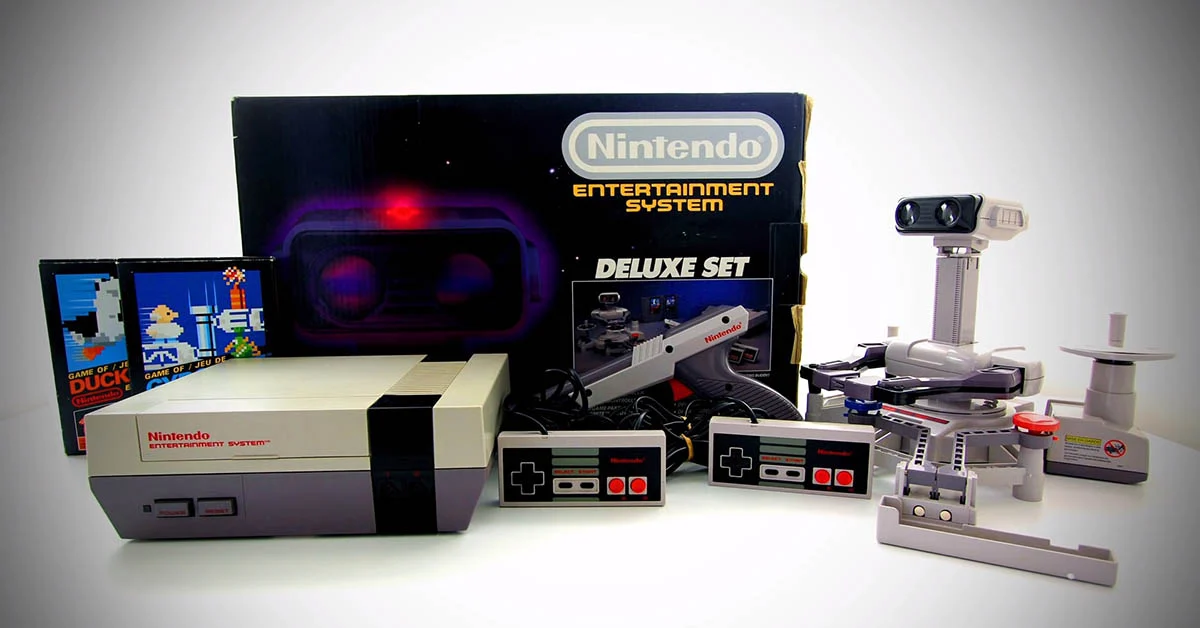
When Nintendo planned its U.S. launch, it avoided the phrase “video game” in marketing. Instead, the NES was introduced in October 1985 as the “Nintendo Entertainment System,” complete with “robust computer-controlled” robot accessories (R.O.B. the Robotic Operating Buddy) to frame it more as an “entertainment toy” than a video console—sidestepping retailers’ video-game wariness.
2.2 Quality over Quantity: The Seal of Quality
Nintendo mandated strict control over software development. Publishers had to enter an exclusive licensing program, guaranteeing that every cartridge met Nintendo’s technical and content standards. The now-iconic Nintendo Seal of Quality assured consumers and retailers that each title was free of game-breaking bugs and adhered to family-friendly guidelines. By limiting licensed titles and enforcing these standards, Nintendo ensured a consistent, high-quality library—restoring trust in home gaming.
2.3 Cartridge Licensing and the 10NES Lockout
To enforce its quality program, Nintendo employed the 10NES lockout chip inside both the console and licensed cartridges. Unauthorized or unlicensed games wouldn’t pass the handshake protocol and simply wouldn’t run. This hardware-based DRM (digital rights management) prevented the flood of knockoff, low-quality games that had contributed to the 1983 crash.
3. Launching with a Stellar Library
3.1 Flagship Franchises
Nintendo ensured that when the NES arrived on store shelves, it boasted a lineup of must-own games:
- Super Mario Bros.: A seamless, side-scrolling platformer that showcased precise controls, secret warp zones, and iconic level design.
- Duck Hunt: Leveraging the NES Zapper light gun, this simple yet addictive game enthralled casual and core audiences alike.
- Excitebike and Golf: Demonstrating the console’s versatility, these titles proved the system could handle both arcade thrills and simulation-style gameplay.
3.2 Third-Party Quality
Nintendo courted and cultivated third-party partners—capable studios like Capcom, Konami, and Square—granting them access to the NES’s development kits in exchange for adherence to release schedules and quality benchmarks. The result was a diverse portfolio, from Mega Man’s tight action-platforming to The Legend of Zelda’s nonlinear adventure.

4. Marketing Mastery and Cultural Impact
4.1 The Nintendo World Championship
In 1990, Nintendo hosted the first-ever national gaming competition—the Nintendo World Championship—ushering in a new era of gaming as a spectator sport. Televised highlights and magazine coverage elevated gaming from a solitary pastime to a communal event, further legitimizing the medium.
4.2 Kid-Friendly Branding
While competitors leaned into arcade-style intensity, Nintendo positioned itself as a family-friendly brand. Its colorful box art, playful mascots (Mario, Link), and joyous soundtracks resonated with both children and parents. Retail displays featured spinning kiosks and demo stations, inviting customers to “test drive” before buying.
4.3 Pop Culture Penetration
By the late 1980s, NES characters transcended their digital origins. Mario and Luigi starred in cartoons like The Super Mario Bros. Super Show!, while a feature film was in development. Every magazine, from Time to Sports Illustrated, ran cover stories on the “Nintendo phenomenon.”
5. Business Innovations That Endure
5.1 Cartridge Licensing Model
Nintendo’s licensing fees and royalty structure—charging publishers for each cartridge produced—became a template for the industry. While later criticized for stifling some creativity, it guaranteed a revenue stream that funded first-party development and hardware R&D.
5.2 Emphasis on Hardware–Software Synergy
Instead of relying on generic off-the-shelf components, Nintendo frequently included hardware enhancements within cartridges (mappers) to expand the console’s capabilities—enabling larger worlds, more colors, and even rudimentary 3D effects years ahead of the competition. This symbiotic approach to hardware and software became a hallmark of Nintendo’s philosophy.
5.3 Regional Lockout and Global Strategy
Nintendo’s lockout protocols extended to region-specific hardware. While limiting cross-region play, this practice allowed the company to stagger releases, tailor content to local tastes, and combat gray-market imports—strategies that persist in modern console cycles.
6. The NES Legacy: A Blueprint for Revival
6.1 Reviving Consumer Confidence
By the early 1990s, the NES had sold over 60 million units worldwide—revitalizing an entire industry. Competitors learned that trust and quality eclipsed sheer volume. Sega, Atari, and later Sony all adopted stricter quality assurance regimes and marketing positioning in response.
6.2 The Birth of Modern Console Generations
The NES model—tightly controlled licensing, striking physical exclusives, and hardware-software integration—informed the strategies of the Super Nintendo, PlayStation, Xbox, and beyond. Today’s console manufacturers continue to enforce stringent certification processes, regional release plans, and first-party development roadmaps traceable back to Nintendo’s mid-1980s approach.
6.3 Cultural Resonance and Retro Revival
Decades after its heyday, the NES remains a cultural touchstone. The success of the NES Classic Edition in 2016—selling nearly 3 million units in under four months—testified to enduring demand for its games and nostalgia-fueled experiences. Emulators, speedrunning communities, and fan mods keep the NES’s library vibrant, proving that Nintendo’s renaissance formula has timeless appeal.
7. Conclusion: More Than Just a Console
When the NES launched, it was more than another gaming device—it was a lifeline. Through meticulous quality control, savvy marketing, and an unwavering commitment to fun, Nintendo transformed a derailed market into an industry juggernaut. The lessons of the NES era—prioritizing consumer trust, fostering vibrant first- and third-party ecosystems, and balancing innovation with reliability—remain guiding principles today. The video game renaissance that followed owes its genesis to those gray-and-red boxes that roared to life in living rooms, parking lots, and department stores, saying, in effect: “Video games aren’t dead—they’re just getting started.”
Article by Dreamstime