The Difference Between Cheats, Exploits, and Accessibility Options explains why similar actions can mean very different things in a game. In many titles a mod or shortcut looks identical at first glance, but intent, authorization, and impact on fairness separate a harmless accessibility toggle from a bannable cheat. This guide gives concise definitions, concrete examples, and clear tests players and developers can use to classify behavior in single‑player, multiplayer, and competitive settings. Readers will leave able to explain why a clip‑through trick is an exploit while remappable buttons are an accessibility tool, and what consequences each carries.
Key Takeaways
- Cheats are unauthorized actions using external tools or software to gain unfair advantages, such as aimbots or memory editors.
- Exploits involve manipulating glitches or unintended game mechanics within the game itself, which may be allowed or banned depending on developer policies.
- Accessibility options are official features designed to help players with disabilities, promoting inclusivity without affecting competitive fairness.
- To distinguish between cheats, exploits, and accessibility features, consider intent, authorization, and impact on fairness.
- Using cheats risks sanctions, bans, and legal issues, while exploits require community and developer judgment; accessibility options are ethically and legally supported.
- Clear classification and communication from developers help maintain fairness, encourage bug reporting, and support inclusive gaming experiences.
What Are Cheats? Definition, Examples, And Typical Motivations
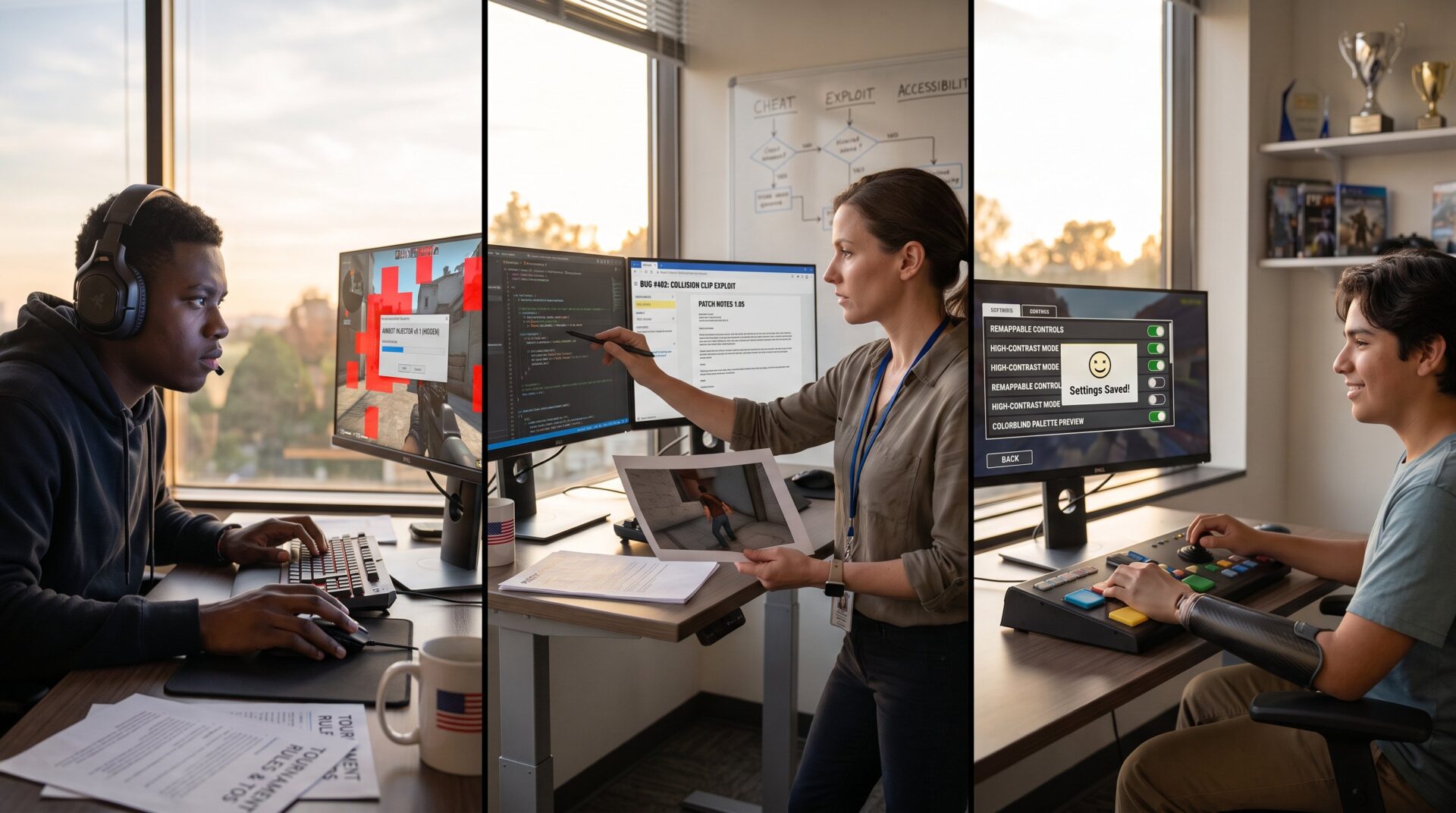
Cheats: unauthorized actions that break the rules to gain an unfair edge. Cheats deliberately subvert intended game systems or use external tools to change outcomes. Common forms include aimbots and wallhacks in shooters, memory editors that change currency, macros that automate inputs beyond human ability, and account boosting for rankings.


Concrete examples: a player using a third‑party aimbot to lock shots: someone editing save files to add rare items: stream‑sniping a tournament competitor to disrupt play. Motivations are measurable: higher rank, prize money, faster progression, or simply the thrill of bending rules. A 2024 tournament investigation showed bans after logs proved automated inputs: that’s a typical enforcement pattern.
Practical test: if an action requires software or changes game files without developer consent, treat it as a cheat. For further reading on player motivations and psychology, see the ThinkOfGames piece on Cheating in Games vs.
What Are Exploits? Glitches, Edge Cases, And Game-State Manipulation
Exploit: using a glitch, bug, or edge case in the game’s own systems to gain advantage. Exploits rely on unintended mechanics that arise from code interactions, not external software. Examples include clipping through collision to skip content, item duplication from a scripting error, or sequence breaks that bypass progression.
Not all exploits look the same. Speedrunners often use exploits like a clipped teleport to finish a category faster: the community may accept that within its rules. But in ranked multiplayer, the same exploit can ruin balance and attract bans. The deciding factor is operator policy: if developers classify it as forbidden, it’s treated as cheating.
A useful practical rule: exploits are internal deviations: cheats are external. When unsure, check patch notes or official bug reports, developers often list exploited behaviors in their rollback or hotfix notes.
Accessibility Options Explained: Intent, Design Goals, And Player Benefits
Accessibility options: deliberate features created by developers to widen who can play. The intent is inclusion, not advantage. Designers add options so players with motor, sensory, or cognitive differences can complete and enjoy content while preserving core competitive integrity.
Concrete benefits: remappable controls let a player with limited mobility adapt inputs: colorblind modes convert ambiguous reds and greens into distinct palettes: adjustable time windows make quick reflex events doable. These are documented and shipped in official builds, they are authorized mechanics.
Decision test: if a feature is listed in options, documented in patch notes, and supported by the developer, it’s an accessibility option. This differs from a cheat even if the effect resembles a shortcut, because the goal is access rather than unfair gain. For a fuller overview, see the full overview.
How To Tell Cheats, Exploits, And Accessibility Options Apart In Practice
Answer first: classify by intent, authorization, and effect on fairness.
Intent: Cheats aim to win or shortcut unfairly: exploits aim to manipulate internal state, sometimes for speedrunning or discovery: accessibility options aim to include. Authorization: cheats are unauthorised, exploits occupy a gray area until developers rule, accessibility features are authorized. Fairness: cheats usually break competitive balance: exploits may or may not: accessibility options should not provide unapproved advantage.
Practical checklist: 1) Was external software used? If yes, it’s likely a cheat. 2) Did the action rely on a bug or physics quirk? Likely an exploit. 3) Is the feature in official menus or patch notes? If yes, it’s accessibility. Players can also consult community resources and the site’s walkthroughs: for help choosing appropriate guides, see the guide selection page.
Ethical, Competitive, And Legal Implications For Players And Developers
Short answer: cheats and many exploits harm fairness and invite sanctions: accessibility options are ethically supported and often legally encouraged.
Ethical issues: cheats undermine trust in matchmaking and damage communities. Developers who ignore rampant cheating risk player loss and reputational harm. Competitive integrity: esports bodies ban software that automates play: repeated offenses lead to suspensions and lost sponsorships. There are documented cases where kernel‑level anti‑cheat systems affected platform compatibility, which shows enforcement has technical and ecosystem costs.
Legal/contractual risks: violating terms of service by using cheats can terminate accounts and void winnings. In extreme cases, coordinated fraud can trigger civil action. By contrast, adding accessibility features is often supported by regulators and praised in press: it can expand audience and reduce legal exposure.
Teams and studios often publish rules: tournament operators post explicit lists of banned actions. When policy is unclear, developers include bug reports and hotfixes that clarify whether an exploit is allowed.
Conclusion
Players and developers benefit when classification is clear: cheats deserve sanctions, exploits require judgement, and accessibility options deserve support. A simple triage, external tools, unintended mechanics, or documented features, helps decide. Gamers should report bugs, avoid unauthorized tools, and advocate for inclusive options. Developers should document rules, ship clear accessibility toggles, and communicate enforcement to keep play fair and welcoming.