
Everyone who ever ripped packs as a kid has had the moment. You find the old binder in a closet, flip to the Charizard, and wonder if you’re holding lunch money or a mortgage payment.


The honest answer is that most cards are worth less than you hope and a few are worth far more than you’d guess. The gap between those two outcomes comes down to condition, print run, language, and whether the card has been professionally graded. What’s changed in the last few years is that you no longer have to guess. The serious end of the hobby now runs on real market data, and the tools that used to be locked inside private spreadsheets are available to anyone.
How Do You Find Out What A Pokemon Card Is Worth?
A card is worth what it actually sells for, not what someone lists it at. That distinction matters more than anything else in this hobby. Listing prices run high because sellers can ask whatever they want. Sold prices tell the truth.
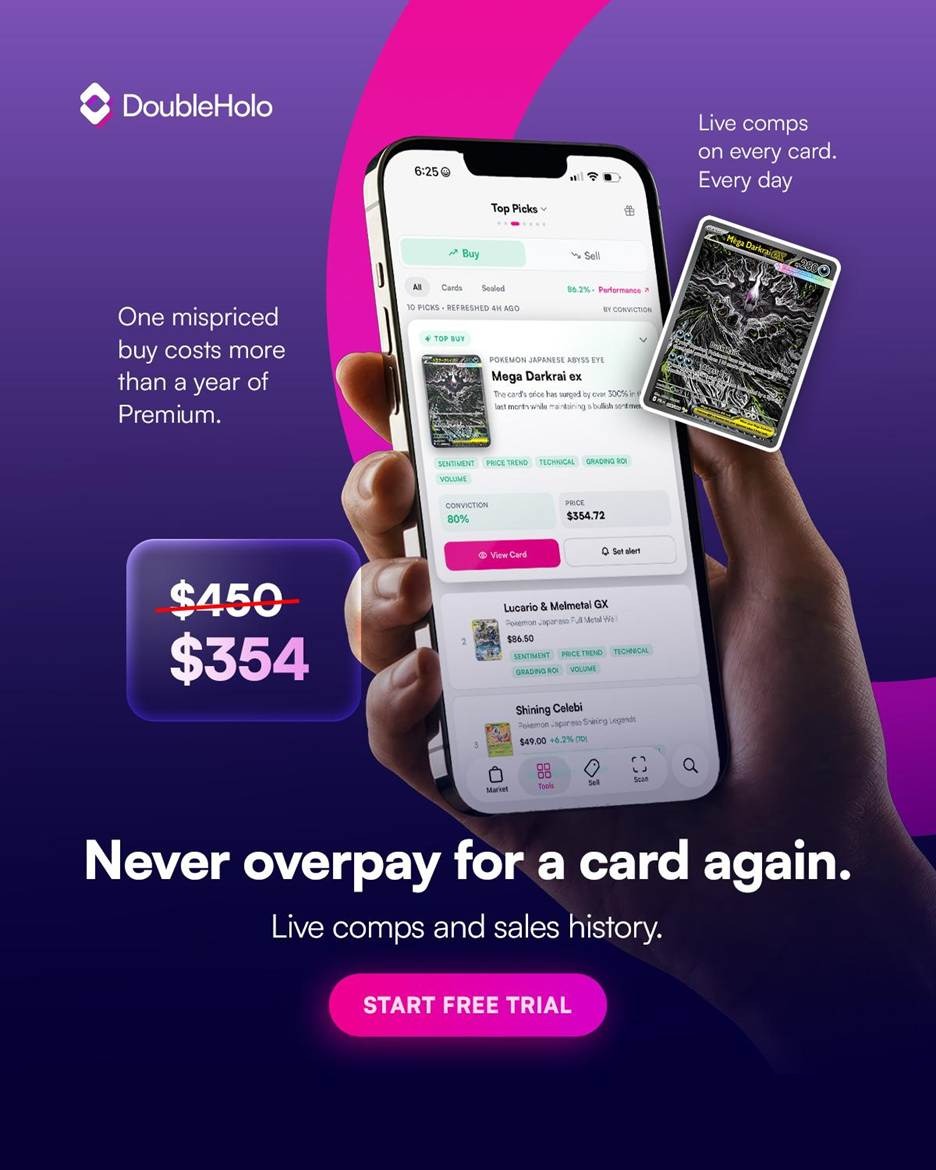
Platforms like Double Holo track sold prices across more than 100,000 Pokemon cards, including Japanese and Chinese-language sets, and show you the price history as a chart instead of a single number. That matters because card prices move. A card that sold for $80 in March might be a $130 card today, or a $40 one. One data point is a rumor. A 30-day trend is an answer.
The other thing worth checking is the spread between raw and graded values. An ungraded card in genuinely mint condition can be worth several times its raw price inside a PSA 10 slab, but grading costs money and a card that comes back a 7 can be worth less than the grading fee. Modern market analytics tools will simulate that math for you before you ship anything, using real graded sales rather than wishful thinking.
Double Holo’s grading ROI simulator shows worst, average, and best case outcomes in dollars for PSA, BGS, CGC, and TAG, which turns “should I grade this?” from a forum argument into arithmetic.
Why Do Two Copies Of The Same Card Have Wildly Different Prices?
Because “the same card” usually isn’t. Base Set Charizard alone exists in shadowless, unlimited, and 1st Edition printings, in a dozen languages, at every grade from 1 to 10. Each of those is its own market with its own price. Language matters more than most people expect. Japanese cards often carry different premiums than English ones, and the collector base for them keeps growing.
This is where a lot of casual sellers get burned. They look up “Charizard price,” see a number for a different printing, and either give a card away or sit on an unsellable listing for months. Checking the exact set, number, and variant takes thirty seconds and is the single highest-value habit a collector can build.
What If You Want To Sell?
You have more options than the usual auction sites, and the fees vary enormously. Double Holo runs a marketplace with low seller fees (4.9%) and a bid/ask system, which means buyers can post standing offers on cards they want. Sometimes the fastest sale is accepting a bid that’s already sitting there waiting for you.
And if selling stops being a one-time cleanout and starts becoming a habit, there’s a whole tier of free tooling most hobbyists don’t know exists. Double Holo’s free Vendor Hub is a complete business management suite built for card sellers, vendors, and local card stores: inventory tracking, a card scanner that pulls live comps through your phone camera, bluetooth price label printing, card show profit tracking, publishing & updating of online listings on Ebay/Shopify, and a deal builder for buying collections. It costs nothing, which is unusual enough in this hobby to be worth saying twice.
FAQ
Are Pokemon cards from the 90s worth money?
Some are. Condition is everything. Played copies of most vintage cards are modest, while high-grade holos from Base Set, Jungle, and Fossil can be significant. Check sold prices for your exact card and condition before assuming either way.
Is it worth grading my Pokemon cards?
Only when the graded value meaningfully exceeds the raw value plus grading fees, and only when the card is genuinely near-mint or better. Run the numbers with a grading ROI tool first. One avoided bad submission pays for a lot of tools.
What’s the best way to check Pokemon card prices?
Use sold-price data with history, not listing prices. Match the exact set, number, variant, and language. A platform that tracks trends over 30 days will tell you far more than a single screenshot of a listing.