

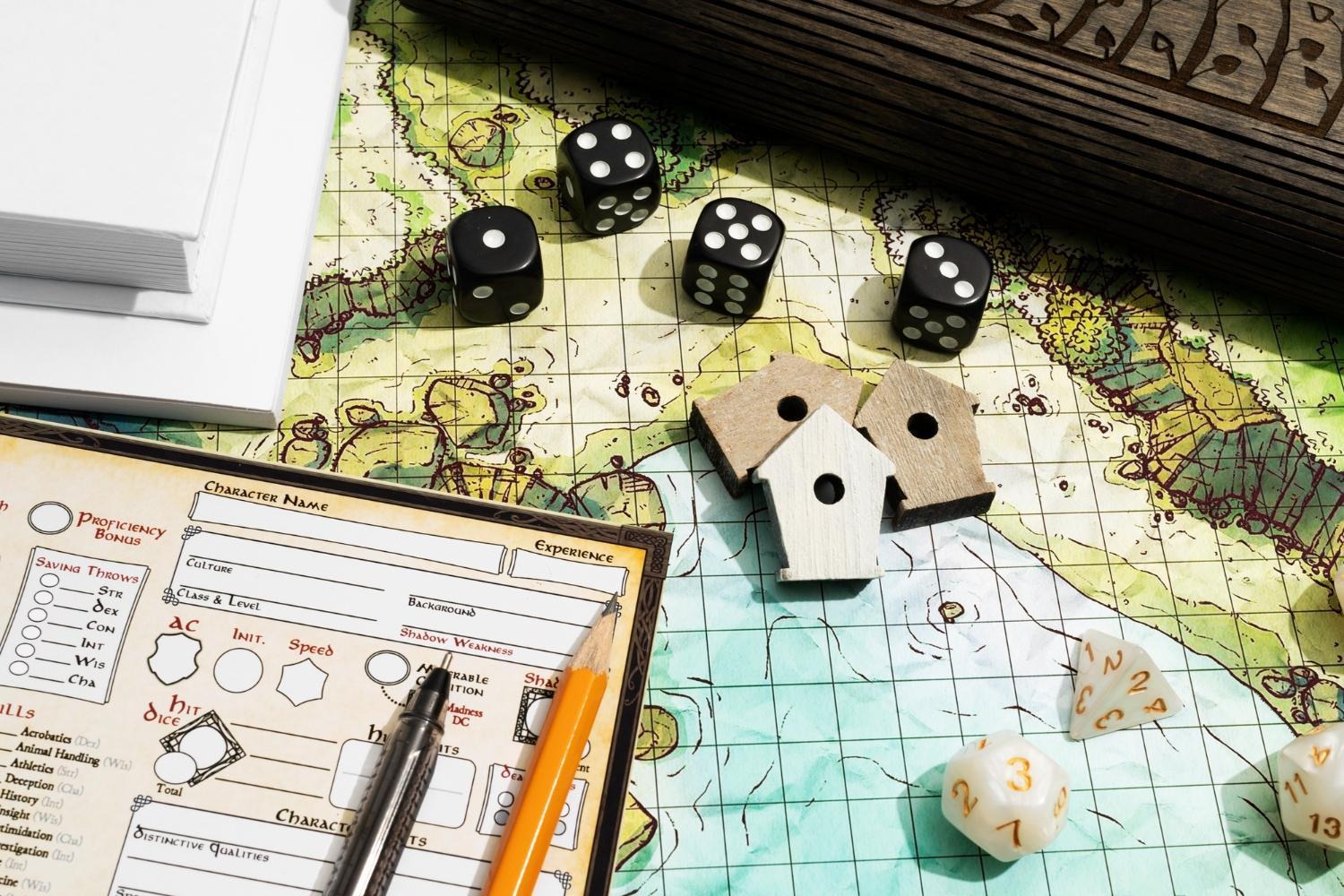
Open a board game box and the rules are right there, in a booklet, in language you can read and argue with. Boot a video game and the rules are somewhere inside a few gigabytes of compiled code, and the only way to find out what they are is to play until the game tells you.
That difference sounds trivial. It isn’t. It shapes how players learn, how arguments get settled, what gets modified, and above all what survives when the game stops running.


Rules You Can Read Versus Rules You Discover
A tabletop rulebook is a specification. It states, in advance, what is legal. If two players disagree, they open the book, find the clause, and settle it. The rules exist independently of any particular play session.
A video game’s rules are enacted rather than stated. The game does not tell you that fall damage scales with velocity above a threshold; it drops you off a ledge and you infer. Everything players know about a game’s systems has been reverse engineered from behaviour, which is why the community wiki is a genuine artefact of collective research rather than a transcription of anything the developer published.
Why Games Feel Different to Learn
This is the reason the two hobbies have such different onboarding cultures.
Tabletop has a designated rules explainer, usually the person who bought the game, doing a five-minute talk while everybody else opens snacks. It is a teaching problem, and the failure mode is a bad explanation of a good game.
Video games teach through a tutorial level, and the failure mode is different: the game withholds information deliberately, because discovery is part of the experience. Nobody wants a soulslike to open with a spreadsheet of damage formulas. But it means the actual ruleset is only ever partially known, even to devoted players.
The Reference Layer Both Hobbies Built
Both sides solved the same problem in opposite directions, and both ended up needing an external reference.
Video games got the wiki, the datamine and the spreadsheet, all built by players from observation. Tabletop got the opposite: the rules were public from the start, so what people needed was clarification, and the reference layer became FAQs, errata, and sites like Playiro that restate published rules in plainer language than the booklet managed. It is a nice inversion. Video game players build reference material because the rules are hidden. Board game players need reference material because the rules are badly written. Same demand, opposite cause.
House Rules Are Only Possible in One of Them
Here is the sharpest consequence, and it is the one tabletop players take most for granted.
If a board game rule is annoying, you change it. Free Parking, no stacking draw twos, everyone starts with an extra card. The rules are a document, documents can be amended, and the group is the authority.
You cannot house rule a video game. You can mod one, which is a different act requiring different permission and different skills, and which the developer can break with a patch or forbid outright. The tabletop player’s casual authority over the ruleset simply does not exist on the other side of the screen.
Which is why the phrase “we always played it that way” belongs entirely to physical games.
Patches Mean Video Game Rules Move
The other asymmetry. A printed rulebook is fixed at the moment of printing. The 1962 edition says what it says forever.
Live-service games change their rules constantly, sometimes weekly. A build that was optimal in one patch is unplayable two months later, and the game you learned is not the game currently installed on your machine. There is no equivalent in tabletop outside of rare official errata, and even then the old book still sits on your shelf, still legible, still playable.
The upside is balance. The cost is that the ruleset has no stable version to refer back to.
When the Rules Stop Existing
And this is where it gets genuinely serious rather than merely interesting.
A board game from 1935 works today. The components are the components, the rules are printed, and nothing is required to play it beyond people and a table. A video game from 1995 requires functioning hardware, a readable disc or cartridge, and increasingly a server that somebody is still paying for. When those go, the rules go with them, because they were never written down anywhere outside the executable.
Institutions have started treating this as the preservation problem it is. The Library of Congress collects video games through copyright deposit and donation, holding thousands of titles at its National Audio-Visual Conservation Center across formats running from 5.25-inch floppy disks to modern console cartridges, along with the packaging, documentation and magazines that surround them. It also publishes a recommended formats statement for software and video games, setting out the technical characteristics and metadata that best support long-term preservation and access.
Note what has to be preserved: not just the game but the documentation around it. Because with a video game, the manual, the strategy guide and the magazine coverage may end up being the only surviving human-readable account of how the thing actually worked.
What Video Games Could Borrow
There is a practical argument buried in this for developers, and a few already act on it.
Publishing the actual numbers, damage formulas, drop rates, scaling curves, costs a studio very little and saves the community thousands of hours of testing. Games that do it tend to have healthier theorycrafting scenes, not weaker ones, because the interesting arguments move from “what does this do” to “what should I do with it.”
The fear is that transparency ruins mystery. In practice the community reverse engineers it anyway, just slower and with more misinformation along the way.
What Board Games Could Borrow
The traffic runs both ways, and tabletop’s weak point is obvious to anyone who has taught a game badly.
Video game tutorials are, at their best, superb pedagogy: teach one mechanic, let the player use it, add the next. Almost no board game rulebook is structured that way. They are written as reference documents and then used as teaching documents, which is why the first game of anything complicated is really a rules rehearsal.
A few designers have started shipping a learn-to-play booklet separate from the reference rulebook. It is an obvious idea borrowed from the other medium and it works.
Two Answers to the Same Question
Every game has to answer how a player finds out what is allowed. Tabletop answers by handing you a document. Video games answer by letting you find out.
Neither is better and both have blind spots, but only one of them produces an object that still works in ninety years. That is worth remembering next time a rulebook seems like an annoying obstacle between you and the game.